AI Design · Craftsmanship · Custom Leather
AI, Leather & Human Hands: From Inspiration to a Real Leather Product
AI is everywhere these days — and yes, we use it too.
But there is something important to understand when it comes to designing leather products:
An AI-generated picture is not automatically a pattern.
It is inspiration.
And between that beautiful AI image on a screen and a finished leather product in your hands, there is still quite a lot of work that needs to happen.
At Plaasjaap, we love using AI to explore ideas, discover shapes and imagine products that we may never have thought of before. It can be an incredibly useful creative tool.
But then the real work begins.
From an AI idea to a leather product
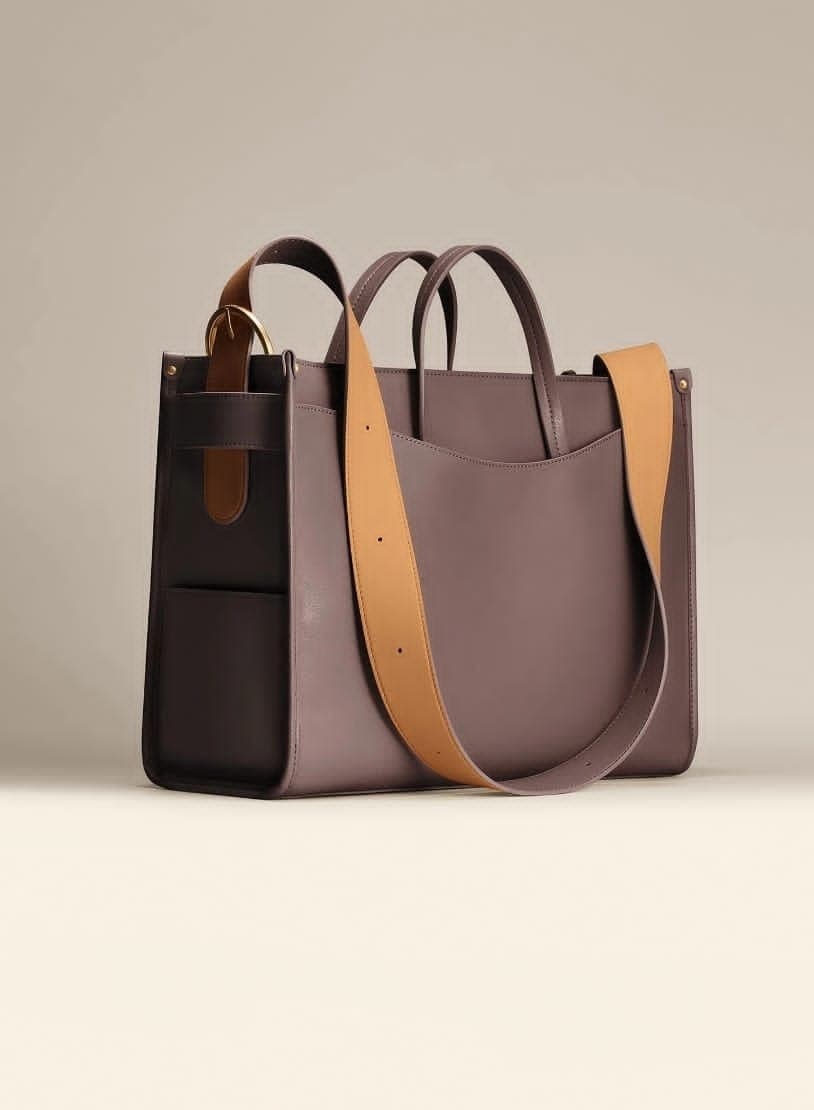
Imagine you show us an AI-generated picture of a beautiful handbag.
It looks perfect.
The proportions are beautiful, the pockets are exactly where they should be, the straps look fantastic and everything seems to fit together effortlessly.
Unfortunately, leather doesn't work quite like a picture on a screen!
Before we can make that handbag, we have to take the inspiration and redesign it specifically for leather and for the way the product will actually be made.
We have to ask questions such as:
- What type of leather will work best?
- How thick or flexible does the leather need to be?
- Is the leather available in the required colour and quantity?
- Which pieces need to be reinforced?
- Where will the stitching go?
- Can the sewing machine actually reach the area that needs stitching?
- How will the corners and curves come together?
- Does the design need lining?
- Where will the hardware go?
- Will the straps carry the weight?
- Can the pieces be cut accurately?
- Can the design be laser cut or engraved where required?
- Can the product actually be assembled without making it unnecessarily complicated?
Those are things an AI image doesn't necessarily know.
Leather is not fabric
One of the biggest differences between designing something digitally and making it from leather is the material itself.
Leather has character.
Different hides have different thicknesses, flexibility, grain, stretch, scars, markings and finishes.
A design that works beautifully in one leather might not work at all in another.
For example, a soft chrome-tanned leather may behave completely differently from a firm vegetable-tanned leather.
A particular design may need structure and support, while another may need leather that can fold and drape.
So when we receive an idea or create an AI concept, we don't simply copy what we see.
We adapt the design to the leather we actually have available.
And sometimes that means changing the design completely.
Then comes the pattern
This is one of the most important steps.
The AI image might show what the finished product should look like, but we still need to create the actual pattern.
Every individual piece has to be worked out.
The measurements, seam allowances, folds, holes, stitch lines, curves, hardware placement and joining points all need to make sense.
If the product is going to be laser cut, the files need to be prepared so that the laser can cut each piece accurately.
That means the pretty picture becomes something much more technical:
a pattern that can actually be manufactured.
And that is a very different thing.
A laser can cut it perfectly… but it can't make the product
This is where we often get asked about our laser.
Yes, our laser can cut and engrave leather with incredible accuracy.
But the laser doesn't know how the finished product should be assembled.
It doesn't decide which leather to use.
It doesn't sew.
It doesn't turn a pile of beautifully cut leather pieces into a handbag, wallet or pouch.
That still requires a person.
There is a big difference between cutting accurately and making something.
Once the pieces have been cut, there can still be hours of work involved:
Preparing → folding → gluing → punching → stitching → fitting hardware → finishing → checking
And sometimes we discover something during assembly that needs to be changed in the pattern.
That is part of the process.
AI is the machine. The hands still have to make it.
This is probably our favourite way of explaining it.
AI can give us the idea. The laser can help us cut it. But human hands still have to make it.
AI is a tool.
Just like a laser is a tool.
Just like a sewing machine is a tool.
Just like a computer is a tool.
The creativity, experience and practical knowledge are still needed to turn an idea into something that works in the real world.
And leather has a wonderful way of reminding you of that!
Why we don't simply copy an AI picture
If you send us an AI-generated design and say, "Can you make this?", the answer may be yes — but probably not exactly as it appears in the picture.
Instead, we will look at the idea behind the design.
What do you like about it?
Is it the shape?
The pockets?
The closure?
The colour combination?
The strap?
The overall style?
Then we can redesign those elements into something that can actually be produced from leather.
The final product might look slightly different from the original inspiration.
And that's okay.
In fact, that's the point.
The goal isn't to reproduce the AI picture. The goal is to turn the idea into a real, functional leather product.
The exciting part
This is where AI becomes really useful for a small leather business like ours.
It allows us to experiment.
We can explore different shapes, combinations, styles and ideas before spending hours making prototypes.
Sometimes an AI image gives us a completely new idea.
Sometimes it gives us half an idea that we then improve.
And sometimes it gives us a design that looks fantastic but would be an absolute nightmare to manufacture!
That's when our experience kicks in.
We simplify.
We strengthen.
We change.
We redesign.
We test.
And eventually, we make it.
From pixels to something you can hold
There is something special about that final step.
An idea that started as a picture on a screen eventually becomes something you can hold in your hands.
It has the smell of leather.
You can feel the texture.
You can see the stitching.
You can open the pockets.
You can use it.
And behind that finished product are not only computers and machines, but also measurements, patterns, leather selection, problem-solving, sewing, finishing and plenty of hands-on work.
So the next time you see an amazing AI-generated leather product and think, "I want one of those!" — send it to us.
We can use it as inspiration.
We'll look at what can realistically be made, what leather will work, how it needs to be redesigned and how we can turn the concept into a proper leather product.
Because at Plaasjaap, we believe that technology can help us imagine what's possible — but it's still human hands that bring it to life.
AI gives us inspiration. Experience makes it practical. Our hands make it real.
And that, to us, is where the magic happens.